

This tour is limited to just 5 clients.
In early March, Poland’s wild landscapes take on a quiet, wintry character that is ideal for wildlife observation. Snow-dusted forests and open wetlands provide exceptional visibility, drawing out a rich variety of birds while increasing the chances of encountering some of Europe’s most iconic mammals. This thoughtfully paced journey centers on two of the country’s most important natural areas—Bialowieza and Biebrza—where ancient habitats and seasonal movements combine to create a rewarding and immersive wildlife experience.
Guided by renowned naturalist Gerard Gorman, we spend unhurried days exploring prime habitats in search of European Bison, moose, and a range of forest and wetland birds, including owls and an impressive diversity of woodpeckers. Comfortable accommodations and short travel distances allow for both focused wildlife viewing and time to appreciate Poland’s cultural traditions, regional cuisine, and the understated beauty of its winter landscapes.


Tour Highlights
- Track European Bison through the ancient, snow-dusted forests of Bialowieza, home to the world’s largest wild population of this iconic species
- Search for a remarkable diversity of woodpeckers and owls, including specialties such as Boreal Owl and White-backed Woodpecker
- Explore the vast wetlands of Biebrza National Park, a haven for wintering waterfowl, raptors, and early returning migrants
- Spot iconic mammals such as moose, Red Fox, Wild Boar, and—if fortunate—Gray Wolf in pristine natural habitats
- Savor traditional Polish cuisine and culture while staying in comfortable lodgings in the heart of these remarkable landscapes
Trip Itinerary
Itineraries are guidelines; variations in itinerary may occur to account for weather, road conditions, closures, etc. and to maximize your experience.
Fri., Mar. 5 Arrivals in Warsaw
Welcome to Warsaw! This is a stunning, vibrant city that is rich in culture and history, and offers delicious food, a beautiful mix of rebuilt historic architecture and was even the birthplace of Marie Curie and Frédéric Chopin. We encourage you to come in early or stay on after the tour to explore local museums, enjoy a Chopin concert, or simply wander the city center and enjoy local foods, drinks, and shopping. Our tour begins this evening with a meet up at our hotel and an opening dinner with your fellow travellers and guide to go over the plan for the days ahead.
Accommodations in Warsaw (D)
Sat., Mar. 6 Bialowieza National Park
After breakfast we drive east to the Bialowieza National Park in the Podlaskie region, around a three hour journey if done direct, but we take our time and stop for any wildlife we see and a lunch break. Lying on the border with Belarus, Bialowieza Forest is listed as a UNESCO World Heritage Site. Some of the forest here is primary, old-growth, composed of both conifers and deciduous trees and littered with both standing and lying deadwood, criss-crossed by small rivers and creeks. It is regarded as the best preserved natural lowland forest in Europe. Ironically, the forest here initially survived as it was set aside as hunting estate for Polish Kings and Russian Tsars and only later came under protection.
The biological diversity of Bialowieza is extraordinarily rich, with innumerable insects, fungi and a host of birds and mammals but ultimately, this forest is famed for being the home of the largest wild population of European Bison. Also known as the Wisent, between 800 – 900 individuals survive here. Compared to their nearest relative, the American Bison, European Bison are on average taller, owing to having longer legs and they are not as “hairy” or “woolly” as their American counterparts. Seeing this iconic species, the biggest and heaviest European land mammal, is one of the highlights of our trip.
Accommodations in Bialowieza (B,L,D)
Sun., Mar. 7 – Wed., Mar. 10 Bialowieza National Park
We have several days to explore the forested habitats of Bialowieza. We stay at the heart of the area in the village of Bialowieza itself and we travel by a small vehicle and on foot on marked trails which enables us to get right into the forest. Dress warmly and in layers! With the in-depth knowledge of our guide and his local friends, we search in particular for the magnificent European Bison, Red Fox, Red and Roe Deer, Wild Boar, Pine Marten, Red Squirrel and, though often more challenging, Gray Wolf.
Another curious animal here is the Racoon Dog that has established itself after being initially introduced into Russia for the fur trade. It is not a relative of the Raccoon, but a canid more closely related to foxes. At this time of year, special birds include the tiny Goldcrest, Fieldfare, Mistle Thrush and Northern Nutcracker. The chickadee family are well-represented, too, with Great, Blue, Willow, Marsh and the delightful Crested Tit all likely to be seen. Other possible birds are Bohemian Waxwing, Long-tailed Tit, Eurasian Siskin, Brambling, European Greenfinch, European Goldfinch and Eurasian Bullfinch. There are a total of eleven species of woodpeckers in Europe and eight are resident in Bialowieza: Black, Great Spotted, Middle Spotted, Lesser Spotted, White-backed, Eurasian Green, Gray-headed and Eurasian Three-toed Woodpecker. The tiny Eurasian Pygmy Owl and Boreal and Tawny Owls are also high on our agenda.
In addition to wildlife, Bialowieza has a rich cultural history and Slavic folk heritage. For example, its Tsar’s Palace and Park was built in the late 1800s and a wooden manor-house from 1845 still stands. And, last but not least, we sample some fine local Polish cuisine such as Zurek (sour rye soup), Borscht (beetroot soup), Pierogi (savory dumplings), Golabki (stuffed cabbage rolls) and Paczki (yeast doughnuts).
Accommodations in Bialowieza (B,L,D)
Thurs., Mar. 11 Biebrza National Park
This morning we drive westwards to the Biebrza National Park, the largest protected area in Poland. As we go, the landscape changes, becoming more open and less forested. We stop as we see raptors and Great Gray Shrikes and Corn Buntings, which typically sit atop roadside trees or on roadside posts and wires. We also visit sites for the often urban-dwelling Syrian Woodpecker, which is the ninth woodpecker species on our journey. Biebrza is typified by marshes, peat bogs, meadows and non-intensively farmed land in the valley of the meandering Biebrza River and we have two full days here to explore and search for its wildlife.
Accommodations near Biebrza National Park (B,L,D)
Fri., Mar. 12 & Sat., Mar. 13 Biebrza Region
The various habitats of the Biebrza wetlands and farmlands are another haven for wildlife. Eurasian Beaver, Eurasian Otter, Brown Hare and Eurasian Moose all do well here. The Moose here are the same species as the one in North America, but individuals are usually slightly smaller, lighter in color and have less palmated antlers. Eurasian Beaver are, however, not the same species as their cousins in North America and the two cannot even interbreed.
Once again, we stay in the very heart of the region, which means we only make short drives each day. In contrast to our previous base, at Biebrza we start to find more wetland birds: Greater White-fronted, Tundra Bean and Graylag Geese, Whooper and Mute Swans, Common Goldeneye, Eurasian Wigeon, Eurasian Teal, Tufted Duck and Smew, which is always a favorite. As spring is breaking through, we may see the first Common Cranes, Great Egrets and Great Cormorants that have arrived back from their wintering areas further south. We keep our eyes open for Common Kingfishers, a small but dazzling blue gem, Reed Buntings and Yellowhammers. Raptors like the huge White-tailed Eagle, Rough-legged Hawk, Common Buzzard, Eurasian Kestrel, Eurasian Goshawk, Eurasian Sparrowhawk and Hen Harrier are all probable, too. Corvids like Eurasian Magpie, Eurasian Jackdaw, Hooded Crow and Rook are common and widespread.
Accommodations near Biebrza National Park (B,L,D)
Sun., Mar. 14 Departures
After breakfast we head to the airport in Warsaw, where our tour ends. Please make flights out in the afternoon. (B,L)
-

European Green Woodpecker by Gerard Gorman
-

European Bison by Gerard Gorman
-

Great Spotted Woodpecker by Carlos Sanchez
-

Moose by Gerard Gorman
-

Boreal Owl by Gerard Gorman
-

Yellowhammer by Kim Nelson
-

European Bison by Gerard Gorman
-

White-backed Woodpecker by Gerard Gorman
-

European Greenfinch by Gerard Gorman
-

Polish Wolf by Gerard Gorman
-

Mute Swan by Arlana Powell
-

Coal Tit by Carlos Sanchez
-

Lesser-spotted Woodpecker by Gerard Gorman
-

European Bison by Gerard Gorman
-

European Beaver by Gerard Gorman
-

Bialowieza Forest fungi by Gerard Gorman
-

Red Deer by Gerard Gorman
Cost of the Journey
The cost of the journey is per person, based on occupancy: $6990 DBL / $7450 SGL, from Warsaw. This cost includes: accommodations for 9 nights, meals as noted in the itinerary, professional guide services, local guides, local park and reserve entrance fees, and miscellaneous program expenses. All tips other than your local guide are included (this includes tips for your driver, lodge and staff, day activities, meals and other services).
It does not include roundtrip airfare to and from Warsaw, or items of a personal nature such as laundry or drinks from the bar.
Travel Details
Please plan to make air travel plans only after the minimum group size has been met. We will send you a confirmation email as soon as the trip has been confirmed.
Arrival and Departure Airport: Lotnisko Chopina Warszawa (WAW) in Warsaw
Arrival Details: Please plan flights to arrive March 5, 2027, by 5:00 PM in time for dinner. You will need to taxi to your hotel.
Departure Details: Plan flights to depart March 14, 2027, after 2:00 PM as we have have a 2.5 hour drive back to Warsaw in the morning.
Travel Tips: If you arrive early to explore Warsaw or rest up from your travels, you can book an early night at our first night tour hotel, the Barceló Warsaw Powi?le Hotel. It's located about 20 minutes from the airport. There is a park across the street if you want to stretch your legs after a long flight and the Vistula River is a block away. There are also many things to see in Warsaw including the Old Town area, the Palace of Culture and Science, and several fascinating museums.
-
Gerard Gorman
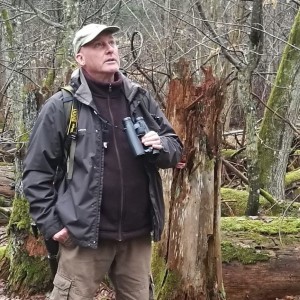
Gerard Gorman is a deeply experienced birding and wildlife guide, particularly in Central and Eastern Europe where his knowledge of the wildlife sites of the region is second to none, having visited every country from the Baltic to the Black Sea. In recent years he has led several Naturalist Journeys groups across Europe and Africa. Gerard is also an author, and his books include Central and Eastern European Wildlife (Bradt, 2008) and Birding in Eastern Europe (WildSounds, 2006). His main ornithological interest focuses on woodpeckers, and he is regarded as an authority, authoring an unprecedented seven books on the family, including the acclaimed Woodpeckers of the World (Bloomsbury, 2014) and Woodpecker (Reaktion, 2017). His latest works include, The Wryneck (Pelagic Publishing, 2022), the definitive monograph on this fascinating species, and The Green Woodpecker (Pelagic Publishing, 2023). Gerard is also interested in wildlife tracking, and his Pocket Guide to Tracks and Signs of European Wildlife (Bloomsbury) was published in 2014.
Photo credit: probirder.com
Other trips with Gerard Gorman
-
 Captivating Croatia: Birding the Adriatic CoastApril 9 - 21, 2027
 -
 The Czech Republic: Birds, Nature, History & Culture FULL - See our Greece departure!April 25 - May 4, 2027
 -
 Finland & Norway: Birding & NatureJune 4 - 16, 2027
-
Photo credits: Banners: European Bison by Gerard Gorman