


- Overview
- Full Itinerary
- Extensions
- Photo Gallery
- Costing
- Travel Details
- Trip Reports
- Guide
- Know Before You Go
Join us on this summertime journey to Hokkaido, the most active season on Japan’s wildest and second largest island. Enjoy wildflowers and an impressive dawn chorus as we visit five of the astounding seven national parks on Hokkaido. This South Carolina-sized volcanic island is covered with magnificent mountains, peat-moor wetlands, deciduous forests, rivers, marshes, and clear lakes. It is also an important agricultural area, home to expansive and bird-friendly rice paddies and grain crops.
Japan's northernmost prefecture is also home to the country’s most complete array of bird and mammal species, including half of its birds, and predators like foxes, and the largest population of Ussuri Brown Bear outside of Russia. Iconic birds of Hokkaido include Red-crowned Crane, Steller’s Sea Eagle, White-Tailed Eagle, and Blakiston’s Fish-Owl. Sperm Whales and Orcas are among the many sea mammals and birds we see on nearshore cruises.
During our winter trips, temperatures below zero are common and snow and ice dominate the scenery. But summer is fresh and bright! Hokkaido transforms into a different world, full of wildflowers and singing and nesting birds. We enjoy cultural delights here as well, including authentic regional cuisine, hot-spring onsen accommodations, and while in Abashiri we visit the Hokkaido Museum of Northern Peoples to learn about the original inhabitants of Hokkaido, the Ainu.
Our dynamic guide team from Japan, Bryan and Koichi, can’t wait to share Hokkaido with you!


- “A good mix of nature and culture…Great that Bryan could explain the intricacies of Japanese life to us-would be difficult to negotiate without bilingual guides. Bryan made each person feel like he/she was his main focus. Really appreciated he and Koichi helping to make our son's trip special (the only one in the group below 40).” — Doris Gertler, 2023 Traveler
- “Fantastic! I can't imagine a better itinerary for winter. The landscapes were breathtaking: volcanoes, fallow fields, rolling with snow-covered forests, running Red Foxes, and
- crazy deer. Highlights: Blakiston’s Fish-Owl, ‘We can see Russia from here’ seabirds, including Red-faced Cormorant, and Sunrise with Red-crowned Cranes. Go-go-go...rigorous, but worth it.” — Katherine Regester, 2023 Traveler
- “It would be hard to say enough good things about Bryan Shirley. He knows his birds and where to find them; he takes good care of his group members; he makes sure that everyone has seen the bird; he's friendly with the group and with the locals; and his knowledge of Japanese is extensive.” — Daphne Byron, 2023 Traveler
Tour Highlights
- Discover Japan’s wild side on an itinerary based entirely on Hokkaido
- Experience the wilds of Northern Japan in five national parks
- Spend two nights in the newly opened lodge on Teuri Island — estimated to have over 1 million breeding seabirds including over 400,000 pairs of Rhinoceros Auklets
- Catch prime time for northern breeding birds like Siberian Rubythroat, Japanese Robin, Long-tailed Rosefinch, and many more
- View Red-crowned Crane with chicks in Kushiro Shitsugen National Park
- Enjoy a scenic boat cruise along the Shiretoko Peninsula to look for Spectacled Guillemot, Sperm Whale, and Orca, and of course enjoy the amazing scenery
- Spend two nights at a traditional Japanese Onsen (hot spring) hotel with a good chance of Blakiston’s Fish Owl feeding just outside the lodge windows
- Enjoy the spectacular scenery from a gondola up the highest mountain in Hokkaido and look for high elevation species like Japanese Accentor and Red-flanked Bluetail


Trip Itinerary
Itineraries are guidelines; variations in itinerary may occur to account for weather, road conditions, closures, etc. and to maximize your experience.
Mon., June 7 Welcome to Japan
Tokyo has two international airports — we recommend you come in at Haneda as our internal flight tomorrow is from Haneda and we stay tonight at a hotel near Haneda Airport. Our tour officially starts tonight with a welcome dinner.
Accommodations at Tokyo Metropolitan Hotel (D)
Tues., June 8 Fly to Hokkaido
This morning we take a walk to the nearby river for our first Japan birds. Eastern Spot-billed Duck, Gray Heron, Great-crested Grebe, Little Tern, and others breed along the river. Gray-cheeked Starling and Large-billed Crow are good representatives of common Tokyo birds and along the river we have a chance at other goodies like Oriental Greenfinch, Brown-eared Bulbul, and Oriental Reed Warbler. Local gardens brighten our pathways as we walk.
Our flight to Kushiro is about two hours; our flight lands on the east end of Hokkaido where our driver/local guide greets us. Near the airport is our first national park of the trip: Kushiro Shitsugen. Shitsugen means wetland and Kushiro Shitsugen is the largest marsh in Japan. The Kushiro River snakes its way south from Lake Kussharo though the wetlands for over 200 km. We enjoy a walk on a boardwalk into the marsh and hope to see endangered Red-crowned Crane that breed here. Other likely birds along the boardwalk include Black-browed Reed Warbler, Chestnut-eared Bunting, Reed Bunting, and both Sakhalin and Middendorf’s Grasshopper Warblers. Latham’s Snipe are common around Hokkaido, and we should see them performing their display flights around the marsh. Part of the boardwalk borders forest and offers a few different species including a chance to find Ural Owl roosting in the large trees.
From there we drive north to one of the most famous birding hotels in Japan. It is a traditional “onsen” or hot spring hotel and we make sure that we arrive in time for those who want to soak in the pools. There is also a bird feeder that gives us point blank photo ops of the more common birds of the area, but the real excitement here starts at dark … there is a pair of Blakiston’s Fish Owls that fish along the river and in the hotel’s fishpond every night!
Accommodations at Yoroushi Onsen (B,L,D)
Wed., June 9 Shiretoko National Park Cruise
Northeastern Hokkaido has a long peninsula jutting out into the Okhotsk Sea. This peninsula is known as Shiretoko and is a national park as well as a UNESCO World Heritage site. The park includes most of the peninsula and the surrounding marine environment. UNESCO describes Shiretoko as “one of the richest integrated ecosystems in the world”. Shiretoko is surrounded by sea ice in the winter, which plays an important role in supplying nutrient rich waters that form the base for the marine ecosystem and sustains the key terrestrial species like Brown Bear and Blakiston’s Fish-Owl. Today we visit the south side of the peninsula. Normally we see a nice pod of Orca, and Sperm Whale are common. We hope to see a few sea birds as well. Streaked Shearwater are common and although Short-tailed Albatross only breed in southern Japan, non-breeding sub-adults are frequently seen here in the summer. Besides the wildlife, the disputed island of Kunashiri is shockingly close and the Shiretoko Mountains to the north make the scenery quite stunning.
This evening we enjoy another fabulous meal at Yoroushi and another chance for the Fish-Owl as well.
Accommodations at Yoroushi Onsen (B,L,D)
Thurs., June 10 Mashu Akan National Park and Lake Tofutsu Wild Flowers & Birds
Hopefully the owl didn’t make us wait up too late last night, but today we plan on a very leisurely morning. We may take an optional walk along the river, or others may opt for more time to enjoy the hot springs or watch the bird feeders, plus the breakfast here is fabulous!
Once we leave our first stop is at Akan Mashu National Park. We stop at an overlook that gives us fabulous views of Lake Mashu, a large crater lake known for crystal clear water. At the overlook we sometimes see Oriental Cuckoo, and with luck Northern Hawk-Cuckoo is possible as well. We also take a short walk around a mountain spring where we keep an eye out for Brown Dipper, several species of woodpeckers, and if we’re lucky Japanese Robin.
Once we leave the national park we cross a pass onto the north side of Hokkaido. We follow the coast with views of the Okhotsk Sea as we work our way toward Abashiri. We stop at Lake Tofutsu and take a walk through the wildflower park. Besides the flowers, we hope to see Siberian Rubythroat, Amur Stonechat, and Long-tailed Rosefinch in the brushy areas before we continue onto our hotel in Abashiri.
Accommodations near Abashiri (B,L,D)
Fri., June 11 Lake Saroma | Wakka Primeval Flower Park & Museum of Northern Peoples
We start our next exciting day just west of Abashiri. Sandwiched between the Okhotsk Sea and Lake Saroma lies a coastal grassland known as Wakka Primeval Flower Park. It varies between 200-700 meters from the lake to the sea, but is over 20 km long and home to more than 300 species of wild flowers. Trails meander through the grasslands where we enjoy the flowers and search for the breeding birds. One of the birds we are on the lookout for here is Lanceolated Warbler—always a skulker!
In the afternoon we visit the Museum of Northern Peoples. Before the arrival of the Japanese from the south and Russians from the Northwest, Hokkaido, Sakhalin, and the Kurile Islands were occupied by an indigenous ethnic group known as the Ainu. The museum teaches us about their culture and how they were able to survive in this harsh climate. It has a lot of information about all the native cultures of the far north and compares how they were able to survive in the harsh climates they inhabit.
Accommodations near Abashiri (B,L,D)
Sat., June 12 Abashiri | Daisetsu National Park
This morning we have a bit of time for some final birding around Abashiri before we make our drive. We may make time for some species we haven’t seen yet, or perhaps check out the coast and lighthouse just outside of town.
From Abashiri we have about a four-hour drive to Asahikawa where our next adventure awaits. Our accommodations are in a small village that serves as a base for exploring Daisetsuzan National Park—our destination for tomorrow. For those that wish, enjoy an opportunity for a relaxing soak as part of our stay at the onsen.
Accommodations at Asahidake Onsen (B,L,D)
Sun., June 13 Daisetsu National Park | Mount Asahidake
Boasting over 2000 square km and 16 peaks over 2000 meters, Daisetuzan National Park offers some of the most rugged scenery in all of Japan. We start the day with a gondola ride up Asahidake, the highest mountain in Hokkaido. The Ainu name for Asahidake translates to “playground of the gods” and the scenery definitely is inspiring.
The 10-minute gondola ride takes us to 1600 meters elevation (appx 5250 feet) where there are a number of trails to explore the area. Snow often lingers into late summer, but by June most has melted and the area is covered with alpine flowers. Pika enjoy the warm temperatures and fresh food, and this is one of the best places in Hokkaido to find high elevation bird species like Pine Grosbeak, Japanese Accentor, and Red-flanked Bluetail. We do a short, relatively easy hike to a small lake to look for birds and enjoy the alpine scenery. From there if the weather is nice, those of us who are interested in a bit of a more strenuous hike can continue up to the summit of Asahidake while others may opt for a more leisurely walk back to the gondola or return to have a soak or siesta at the hotel.
Accommodations at Asahidake Onsen (B,L,D)
Mon., June 14 Morning Birding | Teuri Island
This morning we bird a bit around the hotel for some birds not found in the higher parts of the national park. The forests of Hokkaido are home to six species of woodpecker: Black, Gray-headed, Great Spotted, White-backed, Japanese Pygmy Woodpecker, and Lesser Spotted. Other birds we hope to see here include the near endemic Brown-headed Thrush and the well-named Narcissus Flycatcher.
We have another drive today to get to our next area, but we break it up with birding stops along the way as time permits. Our next destination is Haboro where we board the ferry for Teuri Island. Teuri is a small island (with an area of just over two square miles) and is famous for being host to over 1-million seabirds during nesting season. It is, in fact, the largest breeding colony of Rhinoceros Auklet in the world and has over 400,000 nesting pairs! Others species like Spectacled Guillemot, Common Murre, and Ancient Murrelet breed in lower numbers. Our day here includes walks around the island and viewing the seabirds from a small boat along the shore. We are extremely excited to be able to include Teuri in our itinerary for the first time! Accommodations were an issue here in the past but a new small lodge catering to birders and photographers recently opened. The amazing wildlife and nice accommodations make this an unforgettable experience for sure!
Accommodations in Teuri (B,L,D)
Tues., June 15 Teuri Island
We have all day to enjoy the amazing sights of this seldom-visited island. Our day is in part dictated by the weather and tides. We may have the opportunity to view the seabirds from a small boat along the shore. There are several places that we can view the seabirds on land as well. Besides the huge seabird colonies, Teuri has a good assortment of other species as well. Over 200 species have been observed on the island and passerine breeders include sought-after species such as Sakhalin Grasshopper Warbler, Chestnut-cheeked Starling, Japanese Thrush, and Siberian Rubythroat. In the evening we are either setting off on a boat just offshore to witness the spectacle of thousands of seabirds returning to the island, or perhaps in a hide at one of the seabird colonies as they fly ashore.
Accommodations in Teuri (B,L,D)
Wed., June 16 Morning in Teuri | Sapporo Area
Today’s activities depend a bit on the ferry times. We definitely make use of the morning with the seabirds as long as time allows before we board the ferry back to the mainland. Once back in the bus, we travel south along the coast towards Sapporo, the largest city in Hokkaido. We are staying tonight near the airport and there are several birding options nearby. Depending on what we have seen during the tour, we may go for a walk along a river where we have seen Mandarin Duck and Crested Kingfisher in the past. Our tour ends tonight with a nice dinner to celebrate the conclusion of our tour.
Accommodations in Sapporo (B,L,D)
Thurs., June 17 Flight to Tokyo & Connect with International Flights
Depending on flight times we may have time to enjoy one last morning walk before we head to the airport for our flight back to Tokyo. Most international flights from Tokyo’s Haneda Airport depart in the late afternoon or early evening so there are lots of options for connecting flights from Sapporo. (B)
Sado Island & Crested Ibis Pre-Tour Extension
Itineraries are guidelines; variations in itinerary may occur to account for weather, road conditions, closures, etc. and to maximize your experience.
Fri., June 4: Arrival in Tokyo
Our guide meets you at the airport and escorts you to the hotel just a few minutes from the airport. We have a nice dinner to get to know each other tonight.
Accommodation near Haneda Airport (D)
Sat., June 5: Tokyo Birding | Bullet Train & Ferry to Sado
We start the day with a walk to a nearby river to do some intro to Japan birding. We expect to find some of the common Tokyo birds like Brown-eared Bulbul, Asian Tit, Oriental Greenfinch and other songbirds singing from the brush and Great Cormorants, Gray Heron, and other waterbirds are along the shore or feeding in the river. If it is clear, Mt Fuji is visible in the distance.
After our birding outing we starts the trek to Niigata by train. The main portion of the trip is on the Shinkansen, or Bullet Train. Our train is called the Toki, which is an appropriate name for a train for a birding group since Toki means Crested Ibis! Once we arrive in Niigata we board the ferry for Sado Island. The ferry is a high speed ferry, making birding tough, but of course we are on the lookout for anything flying past.
Accommodations on Sado Island (B,L,D)
Sun., June 6: Japanese Crested Ibis / Taiko Drums
Sado is the 6th largest island in Japan. Its location off the west coast of Northern Honshu in the Sea of Japan makes for harsh winters and warm summers. Sado is also full of interesting history. The Buddhist monk Nichiren was exiled here in the 13 Century, as were many others during that time period. Sado experienced a gold rush in 1601 and Sado soon became the world’s leading producer of gold. Some of the old mines recently became a World Heritage Site in 2024.
For birders and nature enthusiasts, Sado is famous for another reason. It is the home of the Crested Ibis. Once widespread in Japan and China, the population in both countries suffered huge losses due to habitat destruction and pesticides. It was believed to be extinct in China and in Japan only a few birds were left in captivity. In 2003 the last Ibis in Japan died in captivity. Luckily a small population was discovered in China and thanks to a successful captive breeding program and the support of the local residents of Sado, there is now a healthy population of about 500 ibis. We should be able to view them at a few locations this morning, then we visit the visitor center and captive breeding center to learn more about them and check out the ibis-themed souvenirs!
Sado is also famous for the Japanese Taiko Drums and is home to the internationally renowned Taiko Drum group, Kodo. This afternoon we visit a Taiko Studio and learn about Taiko and have a short lesson to learn to play them too!
Accommodations on Sado Island (B,L,D)
Mon., June 7: Morning Birding | Return to Tokyo
We have one last morning to enjoy Sado and the Crested Ibis before we board the ferry and then train back to Tokyo. We plan on arriving in time to meet up for dinner with those participants not joining the Sado extension. (B,L)
-

Kushiro Shitsugen National Park Scenic by Takumi Koichi
-

Japanese Grosbeak
-

Eurasian Nutcracker
-

Shiretoko Peninsula near Utoro
-

White-backed Woodpecker by Ron Knight via Creative Commons
-

Shiretoko Pass
-

Siberian Rubythroat
-

Falcated Duck
-

Japanese Pygmy Woodpecker
-

Orca Whales by Takumi Koichi
-

Hokkaido Flower Fields
-

Japanese Tit by Alpsdake
-

Red-crowned Crane in Kushiro Shitsugen National Park
-

Mountain Hawk-eagle by Mike Prince via Wikimedia Commons
-

Ainu House, Hokkaido
-

Dall's Porpoise, Shiretoko Peninsula
-

Rebun Island Coast
-

Kushiro Shitsugen National Park
-

Rhinoceros Auklet
-

Sika Deer
-

Cormorants at Shiretoko Peninsula
-

Kushiro River Canoe by Takumi Koichi
-

Daisetsu Flowers by Takumi Koichi
-

Sarobetsu Flower Garden by Takumi Koichi
-

Spotted Seal by Takumi Koichi
-

Japanese Raccoon Dog (Tanuki) by Takumi Koichi
-

Narcissus Flycatcher by Takumi Koichi
-

Lake Mashu by Takumi Koichi
-

Amur Stonechat by Takumi Koichi
Cost of the Journey
The cost of the tour: $7,590 DBL / $8,370 SGL from Tokyo. Cost of the Tour Includes: Accommodations for 10 nights, meals as specified in the itinerary (B=breakfast, L=lunch, D=dinner), park entrance and other activity fees for activities as described in the itinerary, professional guide services, pre-departure materials and miscellaneous program expenses. The internal flights to and from Hokkaido are included in the tour price. All tips other than your NJ guide (optional) and local guide are included (this includes tips for your driver, lodge and staff, day activities, meals and other services).
The cost of the extension is $1990 DBL / $2175 SGL.
Cost does not Include: Round-trip airfare to and from Tokyo, Japan, or items of a personal nature such as laundry, telephone, or beverages from the bar.
Travel Details
Please plan to make air travel plans only after the minimum group size has been met. We will send you a confirmation email as soon as the trip has been confirmed.
Arrival and Departure Airport: Haneda Airport (HND) in Ota City, Japan
Arrival Details: Plan to arrive June 7, 2027 by 5:00 PM if you wish to join the group for dinner
Departure Details: Plan June 17, 2027 flights after 4:00 PM
If you would prefer to overnight (additional cost) in Tokyo June 17, you can depart at your leisure on June 18.
Extension Arrival Details: Plan to arrive June 4, 2027 by 5:00 PM if you wish to join the group for dinner
Travel Tips: If you arrive early we suggest booking an early night at our first night tour hotel, the Tokyo Metropolitan Hotel. You can book online and send us your confirmation number, with the goal being you won’t have to switch rooms. If you would like to book a different hotel, there are many options and it’s best to work with your travel agent to find something that best suits your needs.
If you’d like to explore Tokyo, there are an endless number of things to see! The Anamori Inari Shrine is located near the hotel and is an early 19 th century Shinto shrine that has dozens of fox statues. Other shrines worth visiting are the Asakusa Shrine, the most famous in Tokyo, and the Meiji Jinjgu Shrine, dedicated to Emperor Meiji and also located in a park with good birding. If you’d like to visit botanical gardens, the Hamarikyu Gardens are nice to walk around and can be good for birding, even in winter. Do you prefer museums? The Sumida Hokusai Museum features exhibits on the life and art of Katsushika Hokusai, recognized as one of Japan’s greatest artists. The Edo Tokyo Museum has exhibits on the history of Tokyo. The Tokyo National Museum is the oldest in Japan and has the largest collection of important cultural artifacts. And finally, if you really want to get an early start on your birding list, head over to Tokyo Port Wild Bird Park, a nature preserve next to Tokyo Bay.
Entry Requirements: See "Essential Information" section under the "Know Before You Go" tab.
Browse below for trip reports and species lists from past versions of this and other tours from this destination.
Japan
- January 2023
- December 2023
- January 2024
- June 2024 (Hokkaido)
- January 2025
- May 2025
- December 2025
- January 2026
- April 2026 (Spring in Japan)
-
Bryan Shirley
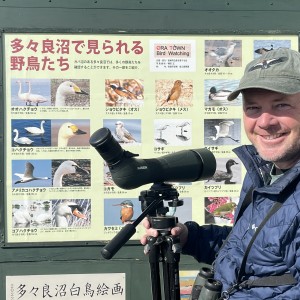
Bryan Shirley graduated from the University of Kentucky with a degree in Japanese/International Economics. He lived in Japan for 3 years when he was 20 and fell in love with the language and culture and has been guiding and birding there ever since. Besides guiding in Japan, he regularly leads tours for Japanese birding groups around the US and other countries. When not guiding he has been involved with various DWR and USFWS projects such as relocating Sage Grouse, breeding bird surveys, and bird-related projects for private environmental consulting firms. He also has volunteered his time to serve as president of Utah County Birders and organizes the annual Audubon Christmas Bird Counts for Provo and Payson, Utah where he currently resides. He currently is a member of the Utah Bird Records Committee.
Other trips with Bryan Shirley
-
 Northern Tanzania: Wildlife & Birding Safari FULL - See our January & February departures.November 7 - 18, 2026, w/Nairobi & Amboseli National Parks extension
 -
 Japan Birding & Nature FULL - Check out Japan in December 2027!January 7 - 23, 2027
 -
 Beginning Birding: BelizeFebruary 23 - March 1, 2027
 -
 Biodiverse Bhutan: Birds, Mammals & BeyondApril 6 - 22, 2027
 -
 Birding Canyon CountryMay 16 - 24, 2027
 -
 Wild Borneo: Endemic Birding & NatureSeptember 3 - 17, 2027
 -
 Japan Birding & Nature December 1 - 17, 2027
 -
 Japan Birding & Nature Full! See our December 2027 tour.January 7 - 23, 2028
-
Essential Information +
Pace & Protocols +
Packing List +
Suggested Reading List +
Useful Links +
Photo credits: BANNERS: Hokkaido Summer Flower Fields (NJ Stock), Blue-and-white Flycatcher (NJ Stock), Red-crowned Cranes (NJ Stock), Smew (NJ Stock), Lavender Field (NJ Stock), Japanese Pygmy Woodpecker (NJ Stock), Baikal Teal (NJ Stock) THUMBNAILS: Red-flanked Bluetail (NJ Stock), Red-crowned Crane (NJ Stock), Japanese Robin (NJ Stock), Blakiston’s Fish-Owl (NJ Stock), Eastern Spot-billed Duck (NJ Stock), Long-tailed Rosefinch (NJ Stock), Hokkaido Brown Bear (NJ Stock), Reed Bunting (NJ Stock)