This thoughtfully designed Costa Rica journey blends rich wildlife experiences with meaningful cultural connections and time to relax, all set against the warm, welcoming backdrop of Guanacaste and the Nicoya Peninsula. From the very first evening, you’ll settle into the rhythm of the tropics, where birdsong greets each morning and evenings are filled with laughter, good food, and the simple joy of being present.

Over the course of the week, explore a remarkable range of habitats—from volcanic landscapes and dry tropical forest to mangroves and vibrant wetlands—each offering new discoveries. Whether soaking in natural hot springs or cruising along wildlife-rich rivers, this journey invites you to experience Costa Rica at a comfortable, unhurried pace.

Tour Highlights

  • Soak in thermal hot springs and rejuvenating mud baths surrounded by lush rainforest
  • Discover Oropendola Waterfall and its forest trails, with the chance to dip beneath the falls
  • Explore the volcanic landscapes and wildlife-rich trails of Rincón de la Vieja National Park
  • Search for monkeys, coatis, and colorful tropical birds along scenic forest walks
  • Cruise the Tempisque River, spotting crocodiles, iguanas, primates, and abundant birdlife
  • Glide through Palo Verde National Park’s wetlands by boat and on foot with a local guide
  • Relax at a charming, locally owned ranch with time for birding, swimming, or a peaceful siesta
  • Connect with fellow travelers over shared meals, daily discoveries, and memorable moments

Trip Itinerary

Itineraries are guidelines; variations in itinerary may occur to account for weather, road conditions, closures, etc. and to maximize your experience.

Tues., Apr. 6    Welcome to Costa Rica! | Lodge Spa

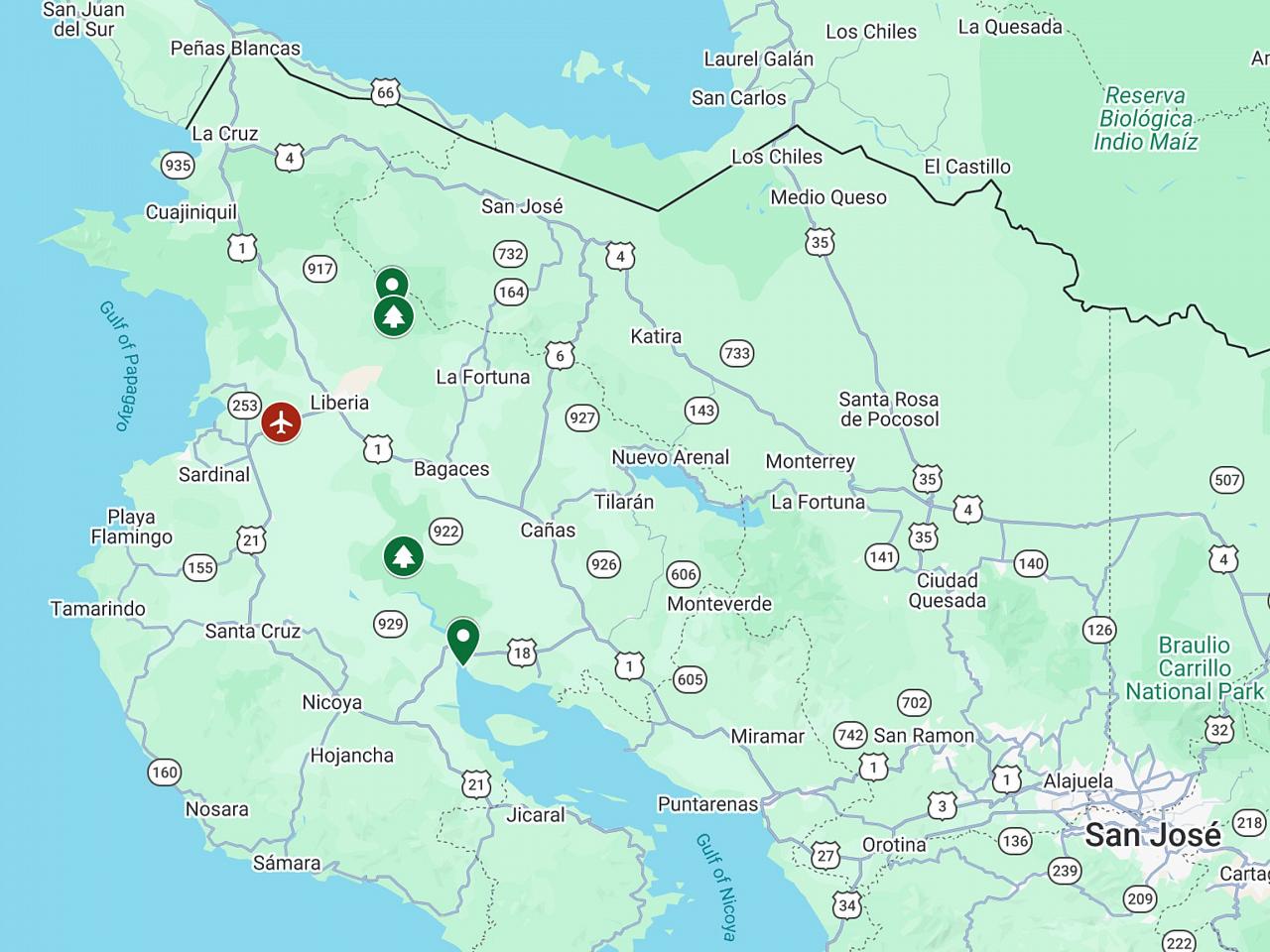
Welcome to Costa Rica! Please arrive today in Liberia, a bustling town of 50,000 on the northwestern end of Costa Rica near the famed Nicoya Peninsula. We meet as a group at the airport and travel together an hour north to the heart of the Guanacaste Province to our first hotel.

Upon arrival, we check into our cozy, bungalow-style cabins, each with private bath and porch that look over the hotel’s small lake. Unpack and head out to explore, this is our home for the next two nights. Birds on the property could include stunning Yellow-throated Toucan, Rufous-tailed Jacamar, Amazon Kingfisher, Rufous Motmot, Masked Tityra, Spectacled Owl, and more classic Neotropical birds, as well as an assortment of over-wintering migrants that you may recognize from home (seasonal, of course). The property, nestled in the mountains and surrounded by rainforest, also includes hot springs, trails, waterfalls, rivers, and majestic views of the pampas and the Pacific coast—indeed, nearly 325 species have been identified here.

Once we settle in, those who wish can head out to the lodge’s thermal pools and mud baths for a chance to relax, ease travel-weary muscles, and soak in the spa’s five hot-spring pools of varying temperatures, all in the heart of a lush, primary rainforest.

Tonight we get to know each other better over dinner, listen to the plans for the week, perhaps go over our first nightly birding checklist of the trip, and settle into our rooms as the sounds of nature lull us to sleep. You are here, and your vacation is underway!
Accommodations at Buena Vista del Rincon Hotel (D)

Wed., Apr. 7      Oropendola Waterfall | Local Birding

Awake to a dawn bird chorus this morning. We enjoy a delicious breakfast at the lodge. Our food is locally-sourced, and farm to table, with many of the ingredients grown in the lodge’s garden. This hotel prides itself on regenerative farming and sustainable food practices, and the care to detail is evident in every meal. Each dining area is nestled within view of the forest, so don’t leave your binoculars in the room. You never know what might show up!

After breakfast, we head out to visit the stunning Oropendola Waterfall; this waterfall is on the property of another local hotel, Hacienda Guachipelin, and we make our way along the path as we dip into the forest. Birds along the way could include the fall’s namesake Montezuma Oropendola, Common Squirrel-Cuckoo, Keel-billed Toucan, Turquoise-browed Motmot, Ferruginous Pygmy-Owl, beautiful Yellow-throated Euphonia, and more. There are many steps and a stepped suspension bridge down to the falls and the viewing platform. These areas can be steep in places, but they are well built and have sturdy hand-rails. From the viewing platform, the adventurous in our group can climb down and take a dip in the sand-bottom river, right underneath the waterfall.

After a delicious local lunch at Hacienda Guachipelin, we bird some more around the grounds before birding our way back to our hotel where we can take an afternoon siesta, bird the lodge trails, and explore some of the intricate flora of the area. Tonight we enjoy another farm to table dinner and our evening checklist. Our species list is growing quickly!
Accommodations at Buena Vista del Rincon Hotel (B,L,D)

Thurs., Apr. 8      Rincon de la Vieja National Park | Rancho Humo

We have a final delicious breakfast at the lodge then depart for Rincon de la Vieja National Park. The park is home to Rincon de la Vieja, the most active volcano in Guanacasta, as well as its dormant sister, Santa Maria. This 25,000 acre park is a UNESCO World Heritage site and home to this 600,000 year old geological wonder that bridges the Continental Divide. We spend the morning hiking along Las Pailas trail, an accessible, 2.5 mile loop trail that leads us through dry tropical forest, passed bubbling hots springs alive with volcanic activity, stunning waterfalls, and possible wildlife including Howler and Spider Monkeys, White-nosed Coatis, possible armadillos, and collard peccaries. Birds we hope to add to our growing list include Black Curassow, Black-headed, Gartered Violaceous, Slaty-tailed and even recently split Elegant Trogons, Long-tailed Manakin, Lesson’s and Turquoise-browed Motmots, Keel-billed Toucan, Red-legged Honeycreeper, Great Black Hawk, Gray Hawk, and Bare-throated Tiger Heron to name just a few. An impressive 448 species have been recorded her.

We enjoy lunch en route to our next hotel on the north end of Costa Rica’s famed Nicoya Peninsula. We check into our hotel, get settled and enjoy some birding on the grounds or at the nearby wetlands, home to impressive Jabiru, or simply enjoy a siesta or dip in the pool before dinner. This lovely, locally owned ranch is our home for the remainder of our tour, so unpack and relax.
Accommodations at Rancho Humo (B,L,D)

Fri., Apr. 9      Rancho Humo Birding

We enjoy a delicious local breakfast this morning before heading out to explore the ranch’s grounds. Our lodge is nestled within a private reserve and has worked extensively to regenerate its numerous habitats, including mangroves, wetlands, tropical dry forest, and pastures. This morning we explore the lodge’s private wetlands on a safari-style tour. The wetlands should be teeming with waders, and species we hope to see include the stately Jabiru, Boat-billed, Tri-colored, Green, and Little Blue Herons, Purple Gallinule, Sora, Roseate Spoonbill, and Wood Stork, as well as other iconic species of Costa Rica like Scarlet Macaw, Northern Jacana, Southern Lapwing, Double-striped Thick-knee, Groove-billed Ani, and more.

Our afternoon is free to enjoy the grounds, take a siesta, take a dip in the pool or enjoy a drink on the veranda and let the birds come to you.
Accommodations at Rancho Humo (B,L,D)

Sat., Apr. 10      Tempisque River Boat Trip

Today we embark on a scenic boat ride along the Tempisque River. This 90 mile river, entirely contained in Costa Rica, originates very close to Ranch Humo and then follows an ever widening path, eventually emptying into the Gulf of Nicoya. The river cuts the Guanacaste province in half, with its lower basin cutting through limestone hills. As we cruise, we watch for sun-warmed iguanas and American Crocodiles on the riverbanks; primates are often seen feeding and moving in family groups amongst the trees along the river’s edge and can include howler, spider, capuchin, and tiny squirrel monkeys. And birds are ever-present, including whistling ducks, Anhinga, Yellow and Black-crowned Night Herons, Double-toothed Kite, Rufous-tailed and Blue-vented Hummingbirds, Green-breasted Mango, Rufous-naped Wood Rail, White-throated Crake, five species of kingfisher, including the tiny American Pygmy Kingfisher, and so many more.

This afternoon we have the opportunity to relax, bird the grounds, take a swim or a siesta, and simply enjoy being in Costa Rica. Tonight, we enjoy dinner and go over our ever-growing checklist.
Accommodations at Rancho Humo (B,L,D)

Sun., Apr. 11      Palo Verde National Park

We set off today, our last full day together, to explore Palo Verde National Park. This park is a mosaic of 15 different habitats, including evergreen, flooded, and deciduous lowland forests, grasslands, mangroves, wetlands and deciduous limestone hill forest. We begin our exploration by boat this morning, with possibilities including more sun-soaked crocodiles, plentiful waders, trogons, Scarlet Macaw, Mangrove Cuckoo, beautifully masked Laughing Falcon, and more. We boat to a walking trail through the park where we explore with a local guide, who talks about the wildlife, habitats, and history of the park and the region. As our walk completes we board our boat and slowly work our way back to the lodge, savoring our time here and adding a few final species to round out the field trip.

Tonight we enjoy a celebratory final dinner together, recounting our favorites birds and other highlights of the trip.  
Accommodations at Rancho Humo (B,L,D)

Mon., Apr. 12      Departures

After one final morning in paradise, our flock disperses today at the airport. (D)


  • Laughing Falcon by Bryan Calk

  • White-faced Capuchin by Bryan Calk

  • Montezuma Oropendola by Bryan Calk

  • birding costa rica

    Rancho Humo

  • Rancho Humo Accommodations

  • Scarlet Macaw by Bryan Calk

  • Red-eyed Tree Frog by Bryan Calk

  • Lesson's Motmot by Bryan Calk

  • Buena Vista del Rincon Accommodations

  • Buena Vista del Rincon Pool Area

  • Keel-billed Toucan by Bryan Calk

  • Buena Vista del Rincon Accommodations

Cost of the Journey

Cost of the journey is per person, based on occupancy: $5990 DBL / $6490 SGL, from Liberia, Costa Rica.

This cost includes: all accommodations, meals as specified in the itinerary, professional guide services, other park and program entrance fees and miscellaneous program expenses. All tips other than your NJ guide (optional) and local guide are included in the cost of the tour (this includes tips for your driver, lodge and staff, day activities, meals and other services).

Tour cost does not include: round-trip transportation from your home city to Liberia, optional activities, or items of a personal nature such as laundry, telephone charges, or beverages from the bar.

Travel Details

Please plan to make air travel plans only after the minimum group size has been met. We will send you a confirmation email as soon as the trip has been confirmed.

Arrival and Departure Airport: Daniel Oduber Quirós International Airport, in Liberia (LIR)

Arrival Details: Plan to arrive April 6, 2027, by 12:00 PM 

Departure Details: Plan flights to depart on April 12, 2027, after 2:00 PM. We have a morning drive back to Liberia. 

Travel Tips: If you want to arrive early to rest up from your travels, we can book you an early night at a convenient hotel near the airport. 

Entry Requirements: See "Essential Information" section under the "Know Before You Go" tab.

Browse below for trip reports and species lists from past versions of this and other tours from this destination.

Costa Rica

Monteverde

Northern

Southern

Essential Information +

This information is important for being prepared for your journey; we want you to have Read more

This information is important for being prepared for your journey; we want you to have the best experience possible. If you only read one section, this one is key!

Ahead of Your Tour

  • Make sure you have a passport that is in good condition and at a minimum is valid from the date of entry through your scheduled return to the U.S. However, to allow for unexpected delays in return travel, we highly suggest at least 3 months validity beyond the date of your scheduled return to the U.S. See "Passports, Visas & Documentation" section below for more information.
  • No visas are required for U.S. citizens for stays of this length. If you are from another country, please contact the Embassy of Costa Rica’s website for guidelines. 
  • Please check current CDC recommendations for travel to Costa Rica and consult with your doctor about general travel vaccinations you should have as precaution for travel. See the “General Health and Inoculations” section below.
  • Travel insurance in case of serious medical emergency is strongly recommended. Full health coverage and repatriation is available through Allianz Travel Insurance.
  • Soft sided luggage/duffel bags are easiest for packing the vans. Pack essential medications in your carry-on luggage, as well as one day of clothing and optics in case of luggage delay.

Passports, Visas & Documents

Guidelines and regulations can change. It is always advisable to double-check the country’s documentation requirements 60-90 days ahead of traveling. Information for U.S. citizens can be found at https://travel.state.gov/content/travel/en/international-travel/International-Travel-Country-Information-Pages/CostaRica.html. If you are from another country, please contact the tour destination’s embassy website for guidelines.

Passport: At the time of writing, U.S. citizens must have a passport that is in good condition and at minimum is valid at the date of entry through your scheduled return to the U.S. However, we highly suggest at least 3 months validity beyond the date of your scheduled return to the U.S. to allow for unexpected delays in return travel. Please check that expiration date! You should have at least one blank page per entry stamp. The blank pages need to say “Visas” at the top. Pages marked “Amendments and Endorsements” will not be accepted. 

Visa: At the time of writing, a tourist visa is not required of US citizens for stays of this length. However, you will need proof of a return ticket. We advise that you bring your eContact list of hotels for use at immigration as well.

As a precaution for lost or misplaced documents you carry on your person during travel, we highly recommend you keep electronic backup copies on your phone (either photo or PDF scan), as well as a copy left with your emergency contact at home. The recommended important documents to copy include, but are not limited to; your passport ID page, travel visa, the front and back of your credit card(s), the airline barcode on your luggage. This will greatly expedite getting new ones if necessary – we hope everyone will always keep travel documents close so that losing them will not be an issue.

General Health & Inoculations Information - Be Prepared!

Health requirements for entry to any country can change. It is always advisable to double-check the country’s health requirements and recommendations 60-90 days ahead of traveling. A helpful website for planning is the Centers for Disease Control and Prevention (CDC) webpage for Costa Rica or by phone (800) CDC-INFO or (800) 232-4636.

We will share your health information with your guide. This information will be kept confidential but is very important as we want to be best prepared in case of medical emergency. 

Mosquito and tick-borne illness: Travelers should reduce their risk of mosquito and/or tick borne diseases (including yellow fever, malaria, dengue fever, zika, Japanese encephalitis, etc.) by protecting themselves from bites using protective clothing, insect repellant (containing DEET, Picaridin, OLE, etc.) and prophylactics where applicable. Check the CDC and with your doctor to see whether your trip destination is currently at risk for malaria transmission and whether you should consider anti-malarial medication. For repellent permeated clothing, see Packing List for our recommendations. See the “CDC Yellow Book: Health Information for International Travel” website for more information: https://wwwnc.cdc.gov/travel/page/yellowbook-home.

Vaccinations:  The CDC recommends that all travelers be up to date with routine vaccines and basic travel vaccines (such as Hepatitis A and Typhoid, etc.). Consult with your doctor for recommendations at least 4- 6 weeks before departing on your trip as some vaccines may require more than one dose and time to become effective.

Yellow Fever: If you are traveling from or through (including airport stop-overs) a country with risk for viral transmission of yellow fever on the way to Costa Rica, you must present a yellow fever vaccination certificate to enter the country (see countries with risk of yellow fever virus (YFV) transmission). If that is the case, but your physician says you should not get a required vaccination due to age, then bring a signed physician’s letter on their professional letterhead saying you are in good health, but they do not recommend that you get the vaccine due to age.

Prescriptions: It is a good idea to pack any meds you take regularly in your carry-on luggage.  Bring an extra pair of glasses or contact lenses. Bring an adequate supply of any prescription medications you use, a copy of the prescription and a list of generic names of your medicines as “back-up” in case it is necessary to purchase drugs while abroad. You’ll want to keep medications in their original, labeled containers. 

Allergies: To be prepared for environmental triggers to allergies or breathing difficulties, please bring your allergy and/or asthma medication(s).  If you have severe allergies talk to your doctor about carrying an EPI pen and notify your guides. It is also recommended to carry with you an up-to-date record of known allergies, chronic medical problems and Medic Alerts so that, if necessary, emergency treatment can be carried out without endangering your health.

Common Ailments: We recommend that you bring a travel-sized first aid kit and a supply of standard over-the-counter medications for prevention or treatment of common ailments (such as diarrhea, constipation, stomach upset, cough, congestion, head or body aches, motion sickness, insect bites and sunburn); as well as ointments, moisturizer, sunscreen, oral rehydration salts, band-aids, moleskin for blisters, cotton swabs, nail clippers, and tweezers, etc.

Weather & Climate

February in Guanacaste Province is generally hot and sunny, and marks the peak of dry season. Expect daytime temperatures to reacho the low-to-mid 90s°F, with cooler nights dropping into the mid 70s°F. Rain is rare during this time of year, and we'll expect mostly clear, sunny skies. As such - don't forget to pack plenty of sun protection! 

You may want to check your favorite weather information website for forecasts and predictions closer to your date of travel.

Annoyances & Hazards

Always listen carefully to any advice given by your local guide regarding pests and other biting insects or reptiles you may encounter.

Mosquito and tick borne illness: Travelers should reduce their risk of mosquito and/or tick borne diseases (including yellow fever, malaria, dengue fever, zika, Japanese encephalitis, etc.) by protecting themselves from bites using protective clothing, insect repellant (containing DEET, Picaridin, OLE, etc.) and prophylactics where applicable. For repellent permeated clothing, see Packing List for our recommendations. See the “CDC Yellow Book: Health Information for International Travel” website for more information: https://wwwnc.cdc.gov/travel/page/yellowbook-home.

Chiggers are a part of lowland and mid-elevation habitats. You may encounter them at grassland or farm locations. Your guide should have a good read on chiggers if it has been wet enough that they are active. Spray your shoes with repellent, and tuck your pants into your socks. When back, be sure to shower and air out your clothing.

Food & Drinks

Menus at lodges and restaurants are varied, sustainably based on the wonderful local ingredients available, and delightfully prepared in a sanitary environment. As with any case when traveling we urge you to consider what your body is used to before you eat something. Trust your common sense when consuming food and beverages. This is the best way to avoid any unwanted problems. Meals reflect the contributions of American, European, Spanish, and local cuisines.

Purified drinking water will be made available to refill your reusable water bottle.  One of the many ways we strive to do our part for the environment is by intentionally reducing our consumption of plastics, however bottled water will be available for field trips where refilling your water bottle is not an option. 

There are some great refillable water filtering bottles on the market today that are great for travels abroad. We encourage you to invest in one (such as Lifestraw or GRAYL Ultrapress or SteriPen). A little research will be well worth the effort to reduce the reliance on single-use plastics when purified water refills are not readily available.

Packing, Clothing & Laundry

See “Packing List” tab for more detailed information and checklists, but in summary, we emphasize that you pack light in soft-sided luggage (easier to load in vans and charter planes), plan for dressing comfortably in layers (for managing varying conditions in any given day), and please pack your personal medication, travel documents, optics, and other essential items in your CARRY-ON, not in your checked luggage. Laundry services are available at most lodgings for an additional fee, but be prepared to hand launder if you need to. 

Spending Money

The official currency of Costa Rica is the colón (CRC). For the current exchange rate, please refer to an online converter tool like www.xe.com, or your bank. The U.S. dollar is also frequently accepted by businesses in Costa Rica. You’ll want to bring small denominations of U.S. dollars ($1, $5, $10, $20) in good condition (crisp and unsoiled with no rips or tears). We advise you carry a mix of different types of payments, such as cash, an ATM card, and a credit card.

Since U.S. dollars are widely accepted, there is no need to exchange currency before your trip. You will want to exchange a small amount of money once you’re in Costa Rica to have local currency for situations that may require it. Local vendors, particularly for crafts, and smaller food establishments, only take local currency. You will be able to change money after your arrival at ATMs, banks, or hotels. ATM machines are available in Liberia, and in larger cities, but not as readily as they are in the US. The ATM will give you local money and your bank will convert that into U.S. Dollars. Many banks charge a fee of $1 - $5 each time you use a foreign ATM. Others may charge you a percentage of the amount you withdraw. Check with your bank before departure. You must become familiar with how to use your ATM card and PIN number ahead of the journey.

Credit cards are commonly accepted throughout Costa Rica. We suggest you have more than one card available, if possible. You may want to bring more than one brand of card (one Visa, and one MasterCard; American Express is less accepted). At some lodges you can keep a drink tab and pay with credit card upon checkout. Not every shop will accept every card. Some smaller shops and restaurants require cash, so it is always a good idea to ask before making a purchase. Also, we recommend that you advise your bank or credit card company that you will be traveling to Costa Rica to avoid questions, card freezes, or charges. If you have a choice of cards, bring one with no foreign exchange fees.

Traveler’s checks are not widely accepted. They can be difficult to exchange. We do not advise you use them.

Gratuities

We hope that you will be pleased with all professional services offered on this tour. All tips for all services of your tour are now included in your tour price, with the exception of your main guides. The local guide is your main guide, if there is more than one, they will share your gratuity. The recommended rate is $10.00 - $15.00 per day per guest. You may also wish to tip your Naturalist Journeys guide/host if you have one on your tour; this should be done separately and the same suggested rate applies. We suggest you bring two envelopes or cards to make it easy to share your gratuity at the end of the tour. If you are on an extension, that may be a different local guide for those days.

Tipping to your guide(s) to show your appreciation is entirely at your discretion and should reflect your level of satisfaction of the service provided. If you wish to offer a tip, know that they appreciate anything you care to give. Of course, you are welcome to give more in recognition of exceptional service.

Please note recommended tips are quoted in U.S. dollars. Tips should be converted and paid in local currency.

Cell Phones & Internet Service

Your guide is well connected and can help if any urgent communication need arises. However, it is highly recommended that you travel with a cell phone, if only as a precaution for the unfortunate occurrence of a medical emergency during an outing and needing swift accessibility to critical personal or medical contacts. 

Please check with your wireless provider to see if your phone and service will work in your destination country. Options include activating international roaming, purchasing a local SIM card at the airport (newer phones may not accept SIM cards), or simply turning off cellular service and relying on Wi-Fi to make calls and access the internet. If your phone can connect to Wi-Fi, you may be able to make voice and video calls free of charge. Another option if you have access to Wi-Fi is to use smartphone apps like Skype, WhatsApp, or Viber to send text messages, and make voice calls, or video calls. Many smartphones, tablets, or laptops come with one of these apps pre-installed or you can download for free.

Your hotels and most local restaurants provide Wi-Fi at least in their common areas. 

Make sure if you do NOT want to use your cell phone that you turn off your cellular data. You could incur huge charges if you are not on Wi-Fi. Putting your phone in airplane mode if you mainly use it for photos will save the battery as well. 

Please refrain from taking or making cell phone calls in the vehicles when traveling with other passengers, unless it appears to be an emergency. This disrupts other guests, plan on cell phone call use on your own time.

Electricity

The standard in Costa Rica is the same as in the United States: 110-120 volts AC (60 cycles). Plugs are set up in the same style. However, three-pronged outlets can be scarce, so it's helpful to bring along an adapter for a two-prong outlet. If your appliances plug has a different shape, you may need a plug adapter. For more information: www.power-plugs-sockets.com/costa-rica

Time

Costa Rica is on the same time as our Central Zone in the US. Check www.timeanddate.com before leaving home for your conversion.

Questions?

Please contact Naturalist Journeys by email at clientservices@naturalistjourneys.com or telephone our office at (866) 900-1146 if you have any questions. Many thanks for traveling with us and we hope you enjoy your journey!

Pace & Protocols +

Pace of the Tour & What to Expect You will receive a Schedule-at-a-Glance and list of Read more

Pace of the Tour & What to Expect

You will receive a Schedule-at-a-Glance and list of hotels (our eContact List) a few weeks before your departure. This will serve as an outline for each day and alert you to any recent changes made in the schedule or to our hotels, if needed.

Our journeys are set up to follow the rhythm of nature. Our focus is on birding and nature; we offer full, well-planned field days and often get up early for that magical time around dawn. We generally follow the published itinerary, but we stay flexible to the weather, wildlife opportunities and the interests of the group. Your guide will keep you apprised of the next day’s schedule at each evening meal, noting what to bring and what to prepare for. Questions and/or concerns are welcome.

The pace of our Naturalist Journeys tours is moderate; to fully participate you should be able to get in and out of vehicles several times a day, and walk 1-3 miles over uneven terrain. It is important to participate with a flexible attitude as adjustments may be made in our schedule to make the most of our time in the field or for other purposes at your guide's discretion. We are not a “listing” bird company that drills down on target species, but at times we do wait for those special species unique to the places we visit. During the day, we take time to stop for photos and for educational opportunities to learn about conservation projects, landscapes, and geology. We appreciate other taxa as well as birds, with mammals often the biggest draw but plants and butterflies are also very popular. Our clients often lend their own expertise to the mix.

We like to make meals a fun and memorable part of the experience, too. Breakfasts are often at hotels, and we carry snacks, fruit, and water in the vans each day. Lunches are a mix of picnics in the field (weather dependent) and a chance to dine with locals at small cafes and restaurants. For dinner, we pride ourselves in our homework to keep up with the best choices for dining, choosing restaurants with atmosphere that specialize in local foods. On occasion we keep dinner simple to go back out in the field for sunset wildlife viewing or night walks. In some remote locations, our choices are limited. If you are tired, room service for dinner may be an option you can choose.

Naturalist Journeys International Trips: Guide Role

Naturalist Journeys supports ecotourism and the development of excellent local guides. Once we know our international partners and guides well, we can send out small groups working directly with these trusted partners, adding a Naturalist Journeys guide to assist the local expert when we have a group of 6-7 or more. This helps us keep your costs down while retaining tour quality. The local guide is your main guide. You can expect your Naturalist Journeys guide to be well-researched and often they are experienced in the destination, but their role is not to be primary, it is to help to organize logistics, help you find birds, mammals, and interesting other species in the field, keep reports, help facilitate group interactions, and to keep the trip within Naturalist Journeys' style. Local guides live in the countries we travel to, know the destinations intimately, and are often the strongest force for conservation in their countries. They open many doors for us to have a rich experience.

Smoking

Smoking is not permitted in any vehicle or in any situation where the group is participating in an activity together, such as a vehicle excursion or a guided walk. Please respect all designated smoking areas at hotels and restaurants.

Transportation

As a courtesy to each other, we ask that all travelers please rotate seating. On international trips we may all be in one small bus, on some trips we are in vans, particularly the roomy Sprinter Vans when available. Some areas require us to be in smaller 4-wheel drive or safari vehicles. Rotation allows you to sit with different drivers and alternate front and back seating.

Photo Release & Sharing

We take many group photos and will share photos with the group. And after your tour, we will organize a chance to share photos via Dropbox or Google Photos. Please note that this is our policy and if you prefer to be excluded, we need to know ahead of your tour.

By registering for this tour, you agree to grant to Naturalist Journeys and its authorized representatives’ permission to record on photography film and/or video, pictures of my participation in the tour. You further agree that any or all of the material photographed may be used, in any form, as part of any future publications, brochure, or other printed materials used to promote Naturalist Journeys, and further that such use shall be without payment of fees, royalties, special credit or other compensation.

Travel Insurance

You are traveling in remote areas. Naturalist Journeys strongly recommends you have full medical and evacuation insurance from a company such as Allianz, for all international travel. If you do not have medical coverage or evacuation coverage on your existing travel insurance policy or for some reason elected not to take that out, we advise getting an evacuation plan with Global RescueWorld Nomads, Medjet, Allianz (they can do evacuation only) or a similar company. These plans are typically $300-$400 for a year for multiple destinations. This coverage may be a part of a larger Travel Insurance policy but can also be purchased on its own.

Questions?

Please contact Naturalist Journeys by email at clientservices@naturalistjourneys.com or telephone our office: (520) 558-1146 or toll free: (866) 900-1146 if you have any questions. Many thanks for traveling with us and we hope you enjoy your journey.


Photo credits coming soon.

×

Like what we do?

Sign up for our weekly eNews to stay up to date!

Get to know our favorite destinations each week. We promise no spam.

No Thanks